
AI is no longer just an emerging technology. In just a few years, it has become one of the biggest forces shaping how people search for information, shop online, create content, and get work done. Since ChatGPT brought generative AI into the mainstream, businesses have been racing to weave AI into their products, while consumers continue finding new ways to use it in everyday life.
Keeping up with that demand isn't cheap. The world's largest hyperscalers are spending unprecedented amounts to build the infrastructure behind AI, and many are investing even more than they originally expected. Amazon, for example, guided for about $100 billion in capital expenditures last year but ultimately spent more than $131 billion. Meta also exceeded its initial $60 billion to $65 billion guidance, ending the year with more than $72 billion in capital expenditures (capex).
And they aren't spending simply for the sake of spending. Amazon, Meta, and their peers are building the computing infrastructure needed to power capable AI models and roll out new AI features across their ecosystems.
Covering these changes for Wedbush, analyst Ygal Arounian notes the impact of AI on both the hyperscalers and the broader internet ecosystem.
"Our central thesis is that AI has become the single most impactful swing factor across our internet coverage, reshaping where users start their online journey, how they complete their online journey, and how businesses are building their products and services in response. Nearly every company we are launching on is directly building out its product pipeline to accommodate these behavioral changes. But just because behavior is changing does not mean there is going to be a wholesale change across every aspect of this ecosystem. We believe AI is enabling stronger growth potential, better products, and an overall enhanced user experience across the internet that should only accelerate adoption and monetization opportunities," Arounian opined.
Applying that thesis to individual stocks, Arounian turns to Amazon (NASDAQ:AMZN) and Meta Platforms (NASDAQ:META), comparing the two AI leaders to determine which he believes is the better hyperscaler stock to buy. Let's take a closer look.
We'll start with a look at Amazon, currently Wall Street's fifth-largest publicly traded company, with a market capitalization of ~$2.7 trillion. The company is well-known as the world's largest online retailer, and earlier this year the company surpassed Walmart as the world's largest retailer, full stop. Amazon reported over $716 billion in revenue for the calendar year 2025, compared to Walmart's fiscal 2026 (which ended in January this year) revenue of $713.2 billion.
While online retail is still the core of Amazon's business, and the largest revenue generator, the company has a long-term strategy of expanding and diversifying its overall footprint. In particular, Amazon has become an AI leader over the past several years, which can be seen in some of the company's high-profile products.
Start with the obvious: AWS. Amazon's cloud computing powerhouse has become one of the company's biggest growth engines. In the first quarter of 2026, AWS generated $37.6 billion in revenue, up 28% year over year. Beyond providing the cloud infrastructure that powers much of the internet, AWS has also become a central player in AI, offering a rapidly expanding lineup of AI models, tools, and services.
In addition, Amazon has also moved into the chip business. AI can't run without silicon chips, and Amazon is working to develop these in-house. The company's Trainium chips form a custom-designed AI accelerator family, and one that Amazon is actively working to broaden. During the first quarter of this year, Amazon received a commitment from OpenAI, under which the ChatGPT creator will consume some two gigawatts of Trainium capacity through AWS, to power its own advanced models and workloads in the coming year.
Amazon has also announced that Anthropic, the company behind the Claude.ai model, will use up to five gigawatts of Trainium chip capacity – in both current and future Trainium generations – to provide training and power for its advanced AI models.
The Trainium chips are not the only AI options that Amazon can offer its customers. The company also has the Bedrock AI platform available through AWS, and has been moving to promote it. The company will be collaborating with Cerebras going forward to deliver fast AI inference speeds through Bedrock for large language models – a solution unique among cloud providers. And Meta, which already uses Bedrock at scale, entered into an agreement with Amazon to expand the hardware deployment available to its agentic AI work, improving such functions as real-time reasoning, code generation, and multi-step agent workflows.
These moves, and others, demonstrate Amazon's growing commitment to expanding its AI capabilities, and to extending those services to more and more users. The company has recognized AI as a vital revenue driver.
And its revenues are already soaring. In the first quarter, Amazon generated $181.5 billion in revenue, up 17% year over year. AWS was the largest contributor to that growth, and total revenue exceeded Wall Street's expectations by roughly $4.2 billion. Amazon also reported net income of $30.3 billion, or diluted EPS of $2.78, beating analysts' consensus estimate by $1.14 per share.
The company's cash flows show the impact of the large capital expenditures. Operating cash flow was up 30% for the trailing twelve months, to $148.5 billion, but the free cash flow decreased year-over-year, from $25.9 billion to just $1.2 billion. The company said the decline was driven primarily by a $59.3 billion year-over-year increase in spending on property and equipment. Amazon finished Q1 with $101.8 billion in cash and cash equivalents.
Against that backdrop, Wedbush's Ygal Arounian believes Amazon is one of the best-positioned companies to benefit from the AI buildout.
"We see Amazon's offerings as well positioned to be a leader and capitalize on its AI investments through its core offerings across commerce, advertising, cloud, and more. It can do this as a platform, like through Bedrock, retail and Alexa, and through picks and shovels like through AWS and its Trainium chips. Amazon capex is guided to be $200B in 2026, +56% from $128B y/y. Most of the increase is on AWS AI infrastructure, including data centers, power, servers, networking, and custom Trainium chips, surrounding its Anthropic partnership and other key AI relationships. AWS added 3.9GW of new power capacity in 2025, and Amazon expects AWS to double that capacity by YE27," Arounian explained.
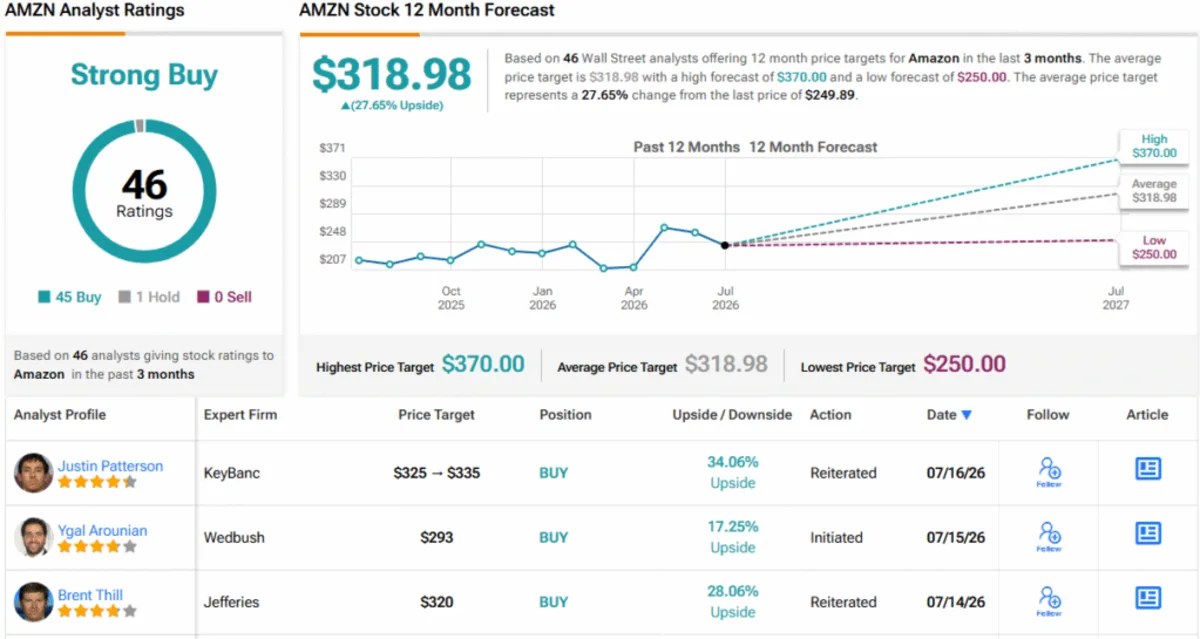
With that in mind, the analyst assigns Amazon shares an Outperform (i.e., Buy) rating, and sets a $293 price target, implying a 17% upside over the next 12 months. (To watch Arounian's track record, click here)
Wall Street is even more optimistic. With Amazon trading at $249.89, the consensus price target stands at $318.98, suggesting about 28% upside over the coming year. The stock also earns a Strong Buy consensus rating, based on 46 recent analyst reviews that include 45 Buys and just one Hold. (See AMZN stock forecast)
Next up is Meta, the social media giant behind Instagram, Facebook, WhatsApp, and Messenger. Together, those platforms give Meta an unmatched global audience. In March, the company's family of apps reached 3.56 billion daily active people (DAP), meaning roughly 43% of the world's population used at least one of its platforms every day.
Meta's huge reach is the company's greatest single strength, and underlies the success of its chief revenue stream: online advertising. Meta's digital ad services brought in some $55 billion in revenue during the first quarter of this year, the last period reported, and made up 98% of the company's total top line. In Q1, Meta's ad impressions, a key metric, were up 19% year-over-year across its family of social apps, while the average price per ad increased by 12%.
As noted above, Meta spent some $72 billion on capex last year; for 2026, the company is on track to nearly double that, projecting a capex of $125 billion to $145 billion. This spike in spending is mainly in support of the company's AI projects, from its Superintelligence Lab, its data center buildout, and its development of proprietary AI processor chips – in short, Meta is following the path that its peers have been blazing. The big question for Meta now – the question that every potential investor wants to answer before putting money down – is how Meta plans to generate a return from all of this spending.
For now, the return on those investments remains more of a future opportunity than a present reality. Investors generally expect Meta to monetize its AI push through subscription-based AI services, business AI tools, and potentially by commercializing some of its computing infrastructure over time. Those opportunities have already proven lucrative for companies like Amazon, Google, and Microsoft, but they also place Meta in direct competition with well-established hyperscale providers.
One thing we do know, however, is that Meta has the financial resources to pursue that strategy. The Q1 report, cited above, showed a total top line of $56.3 billion for the period, up 33% year-over-year and roughly $800 million better than analysts had anticipated. Meta saw a GAAP EPS in Q1 of $10.44, up 62% year-over-year and well ahead of the $6.66 consensus estimate – though that figure was flattered by a one-time $8.03 billion tax benefit; excluding it, adjusted EPS came in at $7.31, still a solid beat.
Turning to Wedbush, analyst Ygal Arounian isn't convinced the AI investment case is as straightforward as it appears.
"Meta has yet to show a broad AI capex return story beyond core advertising improvements. Meta's core ad business continues to benefit from AI-driven improvements to targeting, ranking, and creative tools, and management's engagement data points show real usage growth in Meta AI. However, outside of the ad stack, the picture is less proven: Meta AI/Muse Spark, business AI and subscription tiers, and the prospect of a Meta cloud offering remain early-stage initiatives. That gap between capex intensity and diversified monetization is the central debate for the stock, in our view, and the reason we remain on the sidelines despite Meta's valuation discount to peers," Arounian stated.
That cautious view leads Arounian to rate META shares as Neutral. His $671 price target suggests the stock will remain largely range-bound over the next year.
The rest of Wall Street, however, is more optimistic. META earns a Strong Buy consensus rating based on 41 recent analyst reviews, including 36 Buys and 5 Holds. At the current share price of $664.54, the average price target of $808.66 points to ~22% upside over the coming year. (See META stock forecast)
Having laid out the facts, and looked at both stocks, it is clear that Wedbush sees Amazon as the superior hyperscaler stock to buy in today's environment.
Disclaimer: The opinions expressed in this article are solely those of the featured analyst. The content is intended to be used for informational purposes only. It is very important to do your own analysis before making any investment.