
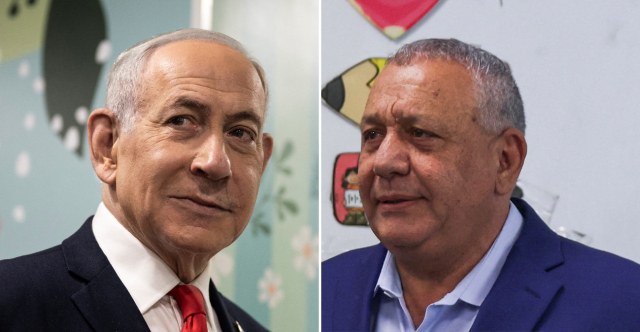
Yashar party leader, Gadi Eisenkot, leaped ahead of Prime Minister Benjamin Netanyahu this week in the effort to secure enough support from the rest of the parliament to form Israel’s next governing coalition. But that doesn’t mean he’ll succeed in his quest to become prime minister.
Yashar won the most seats (21) of any party not aligned with Netanyahu in last month’s vote. But neither the prime minister’s bloc nor the opposition garnered the 61-seat minimum needed to form a governing majority.
Israeli President Isaac Herzog on Sunday will announce who is being given the first shot at forming a coalition. By the end of this week, Eisenkot was able to announce that 67 parliamentarians had endorsed giving him the first chance to do so, compared to 46 for Netanyahu.
That means Herzog is all but certain to tap Eisenkot on Sunday to form a government - but Eisenkot’s path forward remains far from clear.
Eisenkot leads a bloc of four Zionist parties that make up Israel’s so-called change bloc, united by their stated goal of replacing Netanyahu. Together, they hold 48 seats in the incoming parliament, or Knesset, which means they need to enlist the support of parties whose seats total at least 13 to reach the magic number of 61 out of 120 Knesset seats. Or, they could gain a plurality if enough other parties abstain from voting in the new coalition.
Eisenkot has 28 days to negotiate that arrangement once given the opportunity, or mandate, to do so by Herzog, plus a 14-day extension if the president allows it. If Eisenkot fails, another candidate could get a shot at forming a coalition, or another round of elections might loom.
Sixty-seven lawmakers supported Herzog giving Eisenkot the mandate. But that’s different from voting for him to actually take power. Here are the paths he could take, and why each one is fraught.
The first option, which has gained traction in the days since the election, is to cooperate with the ultra-Orthodox parties. These parties have a longstanding alliance with Netanyahu but have served in governments with leaders in the center and left in the past.
There are several indications that such an arrangement may already be taking shape. For starters, United Torah Judaism, one of the two haredi Orthodox parties in the Knesset, told Herzog that it would not endorse either candidate for prime minister - seemingly breaking from the alliance with Netanyahu.
During the consultations with Herzog, the party’s leaders made clear that their support would go to whichever bloc was willing to make concessions on Haredi conscription, including abandoning sanctions against those who refuse to enlist.
If United Torah Judaism, with its 7 seats shifts its support from Netanyahu’s coalition to the change bloc, Eisenkot could secure a plurality, provided the Arab parties at least abstain.
Another indication that such an arrangement may be in the works came from Avigdor Lieberman, leader of the Yisrael Beiteinu party and a member of the change bloc. For years, Lieberman has been best known in Israeli politics for his fierce opposition to the haredi parties.
In a stunning change of course, Lieberman signaled in a Friday post on X/Twitter that he was open to cooperating with the haredi parties to replace Netanyahu - an arrangement that would have been almost unimaginable until recently.
“The election results require all of us to rethink our approach and recognize that there are no good alternatives or magic solutions before us,” Lieberman wrote. He said politicians would need to “show flexibility and make compromises,” including on the issue of haredi military conscription.
“Our national responsibility requires us to make difficult decisions and be prepared for painful compromises,” he added.
The other leaders of the change bloc have been considerably more vague, focusing on the need to replace Netanyahu without specifying how they intend to do so.
“In recent days, I have been advancing a plan with my partners to establish a national emergency government,” Eisenkot wrote on Friday of the four parties that comprise the opposition bloc coming out of the election.
“The logic behind it is to quickly swear in a government based on the four Zionist parties of change and renewal, with any party or Knesset member who agrees to my four basic principles joining immediately or gradually,” he explained. These principles include recognizing Israel as a Jewish and democratic state, accepting the values enshrined in Israel’s Declaration of Independence, mandatory military or civilian service, and recognizing Hamas as a terrorist organization.
But in the same post in which he announced his willingness to compromise with the haredi parties, Lieberman also introduced a potential obstacle that could derail the entire effort. The veteran politician ruled out supporting any minority government, raising the number of seats the change bloc needs to secure to 61. That would require the support of both haredi parties, United Torah Judaism and Shas, rather than just the former.
That is a considerably greater challenge. Shas is considered more right-wing than United Torah Judaism, and its leader, Aryeh Deri, has maintained an especially close relationship with Netanyahu for years. The party also endorsed Netanyahu for prime minister during the consultations. So far, there has been no indication that Shas intends to abandon him, casting serious doubt on the viability of a change-bloc government backed by the haredi parties.
And that is far from the only obstacle facing such an arrangement. One of the central themes of the change bloc’s election campaign was the need to enlist haredi men in the military and change the state’s longstanding approach to their exemption from service. One of the bloc’s strongest campaign arguments was Netanyahu’s unpopular alliance with the two haredi parties. Every leader in the bloc, without exception, pledged before the election not to sit with them in government.
Forming a government with the haredi parties, likely involving significant compromises on military conscription, would be seen by many change-bloc voters as a stunning betrayal.
The first signs of a revolt have already emerged within the bloc. Dan Illouz, an elected Knesset member from Lieberman’s party, wrote on Friday that “we cannot give up on a conscription law,” making clear that he would oppose compromises on the issue.
Another scenario that could theoretically allow Eisenkot to form a government would be to rely on cooperation with another minority, the Arab parties - an arrangement that has long been controversial in Israeli politics. The 19 seats won by Ra’am and the Joint List, the two Arab parties in the bloc, could provide the additional support needed for a change bloc government.
Eisenkot would need active support from Ra’am, the more moderate of the two Arab parties, which previously joined the coalition that replaced Netanyahu in 2021 and has made integration into Israeli society a central part of its platform, alongside an abstention or support from outside the coalition, i.e., not actively joining the coalition, by the Joint List. The more hard-line Arab party has signaled its willingness to engage in unprecedented cooperation with the change bloc to bring down Netanyahu’s coalition.
But here, too, cooperation is far from straightforward, and the obstacles again come from within the change bloc itself.
In addition to ruling out support for a minority government, including one backed by Ra’am, Lieberman made clear that he would oppose any government relying on the Arab parties. “We must not establish a government that relies on the abstention of the Joint List and Ra’am,” he emphasized in his Friday post.
Without Lieberman’s support, cooperation between the change bloc and the Arab parties appears unlikely. It would require the active support of both Arab parties, rather than just Ra’am, a prospect likely to create significant difficulties for members of the change bloc who may be reluctant to cooperate with a party that many Jewish Israelis view as hostile to the Jewish state and the Zionist project. Israeli media have reported that some lawmakers in the bloc have already conveyed that they would struggle to sit in a government with the Arab parties.
Here, too, such an arrangement would represent a clear breach of a campaign promise made by every leader in the change bloc. Eisenkot himself said in a late September interview with Channel 12 News that the Arab parties, including Ra’am, did not meet his conditions for joining a government. Among those conditions, he said, was recognizing Hamas as a terrorist organization.
The third possible route to forming a government would be a national unity coalition between Netanyahu and the change bloc, or at least some of its constituent parties.