
Get Mike Santoli's Market Memo in your inbox first. SUBSCRIBE HERE
The difference between a restorative rest and unhealthy stagnation is time. Distinguishing between resilience and fatigue isn't always easy.
The S&P 500 has been sideways for months, last week dipping to levels first reached on June 1. It has spent nearly all of the last three months within the range the index traveled during a peppy two-day rally Aug. 3-4.
Along the way, the former leaders of the AI trade, captured in the iShares AI Innovation ETF, have collapsed by 35 percentage points relative to the equal-weight S&P 500, then regained half the loss, then gave up most of that bounce.
Aside from giving all of us plenty of time and room for overthinking it, this process of constant churn and testing and positioning shocks has done some good, in a tactical sense.
It has created short-term washout conditions in semiconductors and other former momentum AI-hardware plays. Meantime, the cyclical pockets of the market – from consumer discretionary to industrials to banks - have undergone double-digit setbacks as higher bond yields and elevated oil prices restrain growth expectations.
Equity investors have shown a clear preference for quality and defense, as the debt markets have begun rationing growth capital more stringently, raising hurdle rates for the more marginal AI-data-center borrowers.
Along the way, some familiar intermarket relationships have been scrambled: Treasury yields have stopped moving closely with oil, yields retreating well off their highs as crude stays above $100 a barrel. And the S&P 500's former inverse correlation with Treasury yields has loosened, as the bond market bid seems more tied to hiccups in the AI buildout, which has stymied the Big Tech players.
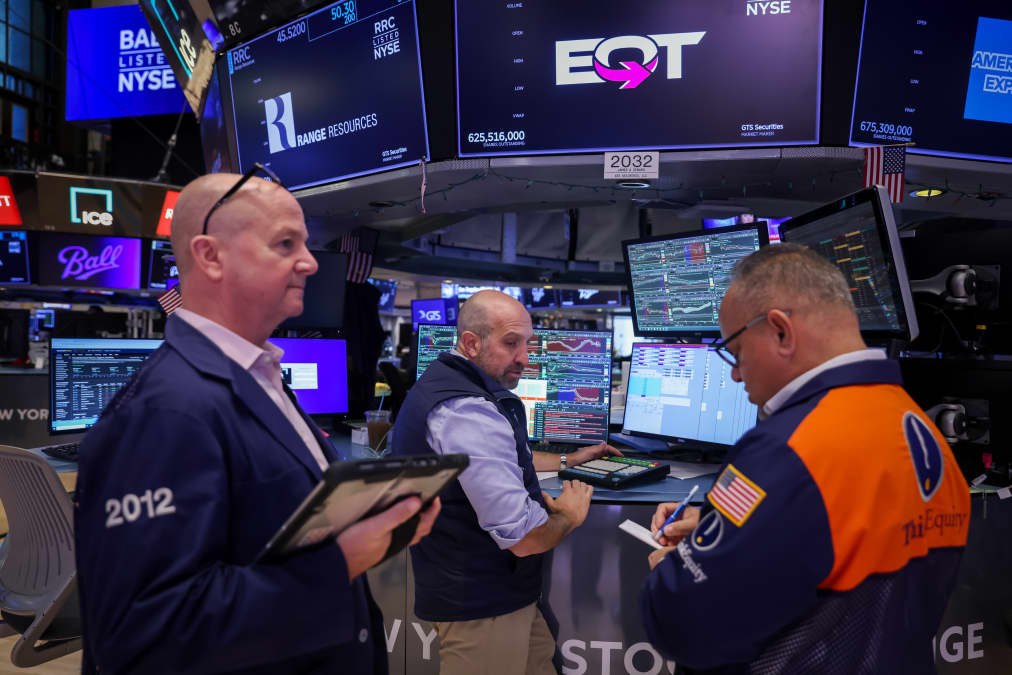
The Goldman Sachs equity desk over the weekend noted "trader exhaustion," in part from the momentum-factor stock basket having moved at least 5% in a day 30 times in 2026 – more often than in any other full year, including ones when there were crashes such as 2000, 2009 and 2020: "Not sure we can handle much more flipping of the thematic script(s)."
Of course, confusion and stress ultimately can reset positioning and attitudes for the good. The sentiment and positioning composite kept by Macro Risk Advisors' John Kolovos that runs here weekly is approaching a "fat pitch" for a tactical rebound, he says. By most measures, hedge funds have radically cut their leverage and exposure to tech. Broad institutional positioning in tech is not far above the Iran-war lows, according to Deutsche Bank, which adds that "the last two reversals higher in tech coincided with strong earnings releases."
This setup takes shape as the mega-cap cloud platforms Alphabet, Amazon and Microsoft report results this week. Further, AI-funding anxiety should arguably ease a bit with the Anthropic IPO filing showing good operating metrics and $100 billion in cash before the IPO proceeds are collected, alongside Blackstone's financing for SpaceX capex and Broadcom lining up $63 billion to fund chips for Anthropic.
It's not quite a now-or-never moment for the AI trade to find some relief, but it's not far from one.
If there's a nagging outlier to the evidence of investor retrenchment and waning risk appetites, it's the ceaseless buying by retail traders of even the worst-looking tech charts.
Scott Rubner, head of equity and equity derivatives strategy at Citadel Securities, wrote on Friday after Thursday's nasty 3% tech selloff, "Despite commentary from several sell-side banks suggesting retail capitulation, our platform data showed the opposite." Namely, the retail order flow Citadel handles as a top market maker revealed extreme dip buying in the leveraged semi ETFs, Micron, Meta and other hard-hit names. This matches data from Robinhood, which according to the firm's Sherwood Media showed its traders stampeded into Bloom Energy on Friday as it fell 11% with the second-highest day ever of net buying in the stock.
While impressive on some level, and even admirable to some, this aggressive buying of severe weakness is not something that has typically coincided with important market lows. Citadel's data tell us that the late-March and late-July bottoms in the market occurred when retail traders panicked out and were net sellers for a week or two.
Not to say that retail's stubborn dip-buying precludes some relief in hard-hit parts of the market, but it likely limits how strong or durable a rally might become.
Market Temperature Gauge
John Kolovos of Macro Risk Advisors on the latest reading: "Sentiment and breadth are finally giving us something to like, and a fat pitch may be approaching, but the macro needs to cooperate. Our studies show that improving momentum amid tight financial conditions has historically produced disappointing returns and left the market dangerously vulnerable to left-tail outcomes or market corrections."
Around the Street
-Sometimes assessing the weight of the evidence requires a long wait for all the evidence. I grant that the anxious churn and valuation compression of recent months has generated conditions for upside surprise and a relief trade higher.
But bigger picture, I want to stay alert to changing atmospheric conditions.
As I've noted in the weeks since this newsletter launched, I think we're feeling late-cycle tremors – narrower market leadership, investors' unwillingness to pay up for fast earnings growth, a flattening yield curve, stingier credit markets.
I've suggested the market might be telling us companies are "over-earning" through front-loaded capex recycling. It's probable that the Iran war and its macro disturbances prevented the AI theme from going full bubble mode, restricting the craziness to semis and related groups. But that doesn't mean we're sure to rebuild toward a broad bubble this cycle.
And I've argued that even if stocks do fine, bonds now offer a useful yield cushion against concentrated equity risk.
Last year around this time, cyclical-sector outperformance, approaching fiscal tailwinds and benign credit conditions were telling us not to worry about economic growth into 2026. So then what are the recent defensive-stock leadership, fading fiscal impulse and unsettled corporate credit whispering in investors' ears now?
I also believe in the laws of mean-reversion, even though they are enforced only sporadically. A post by Ben Carlson of Ritholtz Wealth Management on his "A Wealth of Common Sense" blog details how great trailing 15-year S&P 500 returns have been, and what this could mean looking ahead.
-This writeup by Dario Perkins of TS Lombard entered heavy rotation in the past couple of days, for good reason. It's a nicely articulated and sobering thought experiment on how the AI boom might now be incubating its own nasty bust.
Market on Close
The migration of money toward pure, traditional defensive stocks has been a bit too mechanical to infer that it's entirely a macro "tell," given the clockwork factor rotations that look almost too scripted to be trusted.
Still, the results are a convergence of valuations between consumer staples and technology. This might seem perverse for current-generation investors but there was a time when staples commanded a premium for their stability and enduring brands, while tech was viewed as cyclical and fickle.
Procter & Gamble has long been the class of the consumer-products industry, standing in for quality management in the way Pampers are synonymous with diapers. And somewhat the way Google is interchangeable with looking something up on the Internet.
Whether this crossover in P/E strikes you as the world's proper order being restored or as a screaming buy signal for Alphabet shares is the measure of what sort of investor you are.
SUBSCRIBE TO MIKE SANTOLI'S MARKET MEMO HERE